Review


Similar Products

94
ATCC rosa26 creert2
Rosa26 Creert2, supplied by ATCC, used in various techniques. Bioz Stars score: 94/100, based on 1 PubMed citations. ZERO BIAS - scores, article reviews, protocol conditions and more
https://www.bioz.com/result/rosa26 creert2/product/ATCC
Average 94 stars, based on 1 article reviews
rosa26 creert2 - by Bioz Stars, 2026-03
94/100 stars
  Buy from Supplier

96
MedChemExpress rosa26 lsl tdtomato mice
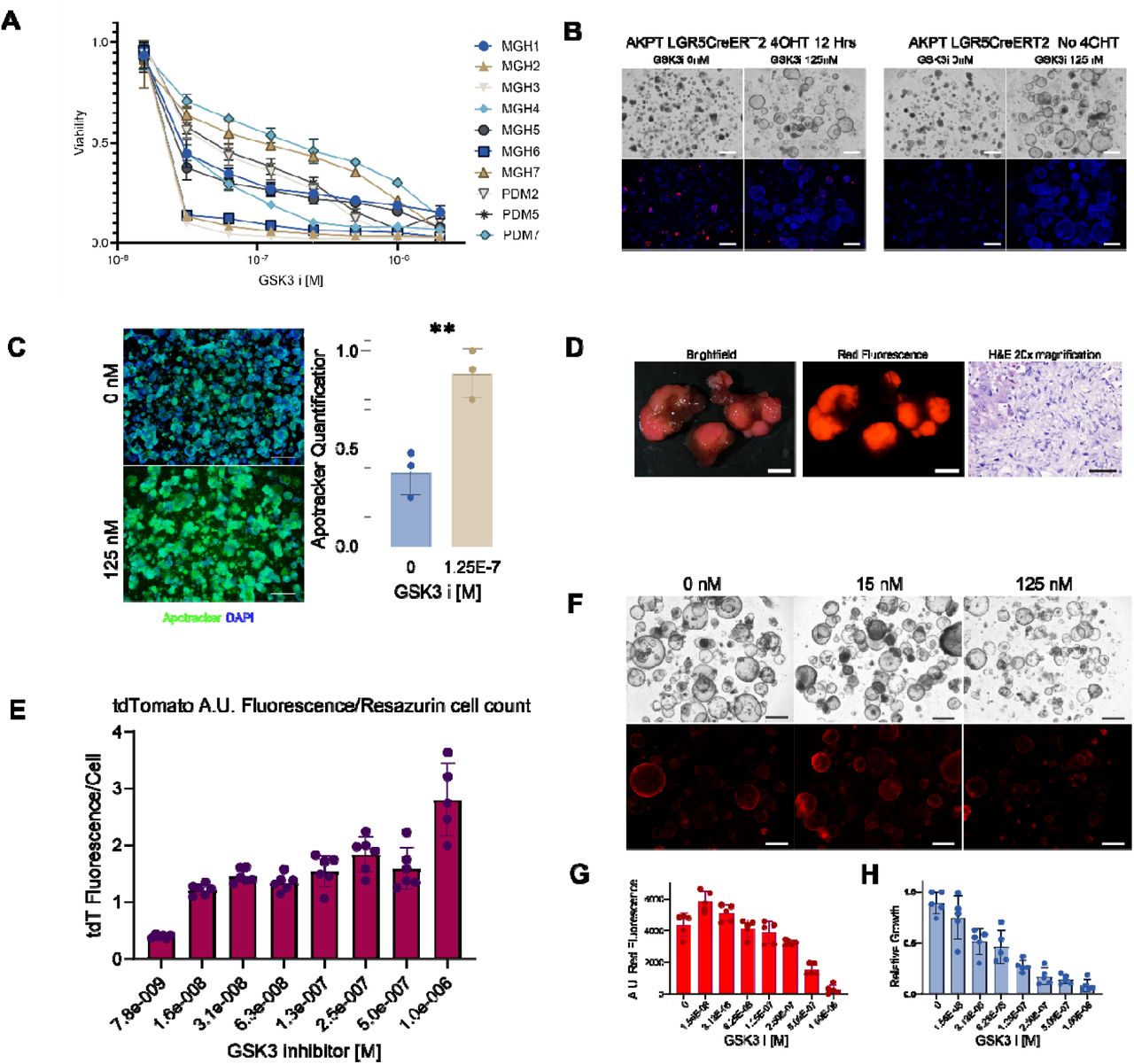
(A) Dose-response curves of GSK3i (LY2090314) treatment across a panel of patient-derived human colorectal cancer organoids. Growth measured by resazurin metabolic assay after 72 hours, normalized to vehicle control. n=10 individual patient samples; demographic and clinical data provided in Supplementary Table 1. Data shown as mean ± SD. (B) Assessment of GSK3i effects on nascent tumor formation. Apc fl/fl ;Kras LSL-G12D ;Trp53 fl/fl <t>;Rosa26</t> LSL- tdTomato ;Lgr5-CreERT2 organoids were treated with 4-hydroxytamoxifen (500 ng/ml) for 12 hours to induce Cre-mediated recombination, then cultured ± GSK3i (100 nM) for 4 days. Red fluorescence indicates successful Cre recombination and tumor allele activation. DAPI (blue) marks all cell nuclei; DAPI-positive/tdTomato-negative cells represent untransformed organoids that escaped recombination. Representative images from n=3 independent experiments. (C) Apoptosis detection in AKP tumor organoids. Representative fluorescence images and quantification using Apotracker dye after 24 hours of GSK3i treatment (100 nM). n=4 biological replicates. **p<0.01, unpaired t-test. (D) In vivo tumorigenicity of Wnt3a-KPT organoids. Left: Gross brightfield and fluorescence images of mouse liver 5 weeks after orthotopic implantation of Kras G12D ;Trp53 -/- ;tdTomato organoids expressing EF1A-driven Wnt3a transgene (Wnt3a-KPT). Right: Hematoxylin and eosin staining confirming tumor formation. Representative images from n=5 mice. (E) Normalized red fluorescence of TOP/tdTomato reporter in human CRC organoids, normalized by cell number, primary data found in U,V. demonstrating WNT reporter activity inversely correlating with cell number across all concentrations. (F,G,H) WNT pathway reporter analysis in mouse colorectal cancer organoids. (F) Representative brightfield (top) and tdTomato fluorescence (bottom) images of Apc -/- ;Kras G12D ;Trp53 -/- (AKP) organoids transduced with 13xTCF-tdTomato (TOP/tdTomato) reporter, cultured with GSK3i dose response for 72 hours. (G) Quantification of tdTomato fluorescence intensity per well from (F). (H) Corresponding growth measurements of AKP organoids by resazurin assay. n=5 biological replicates for (G) and (H). Data shown as mean ± SD. GSK3i = LY2090314 for all experiments. Scale bars: 500 μm (B,C,F); 5 mm (D, gross images); 200 μm (D, histology).
Rosa26 Lsl Tdtomato Mice, supplied by MedChemExpress, used in various techniques. Bioz Stars score: 96/100, based on 1 PubMed citations. ZERO BIAS - scores, article reviews, protocol conditions and more
https://www.bioz.com/result/rosa26 lsl tdtomato mice/product/MedChemExpress
Average 96 stars, based on 1 article reviews
rosa26 lsl tdtomato mice - by Bioz Stars, 2026-03
96/100 stars
  Buy from Supplier

94
ATCC creert2
(A) Dose-response curves of GSK3i (LY2090314) treatment across a panel of patient-derived human colorectal cancer organoids. Growth measured by resazurin metabolic assay after 72 hours, normalized to vehicle control. n=10 individual patient samples; demographic and clinical data provided in Supplementary Table 1. Data shown as mean ± SD. (B) Assessment of GSK3i effects on nascent tumor formation. Apc fl/fl ;Kras LSL-G12D ;Trp53 fl/fl <t>;Rosa26</t> LSL- tdTomato ;Lgr5-CreERT2 organoids were treated with 4-hydroxytamoxifen (500 ng/ml) for 12 hours to induce Cre-mediated recombination, then cultured ± GSK3i (100 nM) for 4 days. Red fluorescence indicates successful Cre recombination and tumor allele activation. DAPI (blue) marks all cell nuclei; DAPI-positive/tdTomato-negative cells represent untransformed organoids that escaped recombination. Representative images from n=3 independent experiments. (C) Apoptosis detection in AKP tumor organoids. Representative fluorescence images and quantification using Apotracker dye after 24 hours of GSK3i treatment (100 nM). n=4 biological replicates. **p<0.01, unpaired t-test. (D) In vivo tumorigenicity of Wnt3a-KPT organoids. Left: Gross brightfield and fluorescence images of mouse liver 5 weeks after orthotopic implantation of Kras G12D ;Trp53 -/- ;tdTomato organoids expressing EF1A-driven Wnt3a transgene (Wnt3a-KPT). Right: Hematoxylin and eosin staining confirming tumor formation. Representative images from n=5 mice. (E) Normalized red fluorescence of TOP/tdTomato reporter in human CRC organoids, normalized by cell number, primary data found in U,V. demonstrating WNT reporter activity inversely correlating with cell number across all concentrations. (F,G,H) WNT pathway reporter analysis in mouse colorectal cancer organoids. (F) Representative brightfield (top) and tdTomato fluorescence (bottom) images of Apc -/- ;Kras G12D ;Trp53 -/- (AKP) organoids transduced with 13xTCF-tdTomato (TOP/tdTomato) reporter, cultured with GSK3i dose response for 72 hours. (G) Quantification of tdTomato fluorescence intensity per well from (F). (H) Corresponding growth measurements of AKP organoids by resazurin assay. n=5 biological replicates for (G) and (H). Data shown as mean ± SD. GSK3i = LY2090314 for all experiments. Scale bars: 500 μm (B,C,F); 5 mm (D, gross images); 200 μm (D, histology).
Creert2, supplied by ATCC, used in various techniques. Bioz Stars score: 94/100, based on 1 PubMed citations. ZERO BIAS - scores, article reviews, protocol conditions and more
https://www.bioz.com/result/creert2/product/ATCC
Average 94 stars, based on 1 article reviews
creert2 - by Bioz Stars, 2026-03
94/100 stars
  Buy from Supplier

90
Jackson Laboratory rosa26-cre ert mice
(A) Dose-response curves of GSK3i (LY2090314) treatment across a panel of patient-derived human colorectal cancer organoids. Growth measured by resazurin metabolic assay after 72 hours, normalized to vehicle control. n=10 individual patient samples; demographic and clinical data provided in Supplementary Table 1. Data shown as mean ± SD. (B) Assessment of GSK3i effects on nascent tumor formation. Apc fl/fl ;Kras LSL-G12D ;Trp53 fl/fl <t>;Rosa26</t> LSL- tdTomato ;Lgr5-CreERT2 organoids were treated with 4-hydroxytamoxifen (500 ng/ml) for 12 hours to induce Cre-mediated recombination, then cultured ± GSK3i (100 nM) for 4 days. Red fluorescence indicates successful Cre recombination and tumor allele activation. DAPI (blue) marks all cell nuclei; DAPI-positive/tdTomato-negative cells represent untransformed organoids that escaped recombination. Representative images from n=3 independent experiments. (C) Apoptosis detection in AKP tumor organoids. Representative fluorescence images and quantification using Apotracker dye after 24 hours of GSK3i treatment (100 nM). n=4 biological replicates. **p<0.01, unpaired t-test. (D) In vivo tumorigenicity of Wnt3a-KPT organoids. Left: Gross brightfield and fluorescence images of mouse liver 5 weeks after orthotopic implantation of Kras G12D ;Trp53 -/- ;tdTomato organoids expressing EF1A-driven Wnt3a transgene (Wnt3a-KPT). Right: Hematoxylin and eosin staining confirming tumor formation. Representative images from n=5 mice. (E) Normalized red fluorescence of TOP/tdTomato reporter in human CRC organoids, normalized by cell number, primary data found in U,V. demonstrating WNT reporter activity inversely correlating with cell number across all concentrations. (F,G,H) WNT pathway reporter analysis in mouse colorectal cancer organoids. (F) Representative brightfield (top) and tdTomato fluorescence (bottom) images of Apc -/- ;Kras G12D ;Trp53 -/- (AKP) organoids transduced with 13xTCF-tdTomato (TOP/tdTomato) reporter, cultured with GSK3i dose response for 72 hours. (G) Quantification of tdTomato fluorescence intensity per well from (F). (H) Corresponding growth measurements of AKP organoids by resazurin assay. n=5 biological replicates for (G) and (H). Data shown as mean ± SD. GSK3i = LY2090314 for all experiments. Scale bars: 500 μm (B,C,F); 5 mm (D, gross images); 200 μm (D, histology).
Rosa26 Cre Ert Mice, supplied by Jackson Laboratory, used in various techniques. Bioz Stars score: 90/100, based on 1 PubMed citations. ZERO BIAS - scores, article reviews, protocol conditions and more
https://www.bioz.com/result/rosa26-cre ert mice/product/Jackson Laboratory
Average 90 stars, based on 1 article reviews
rosa26-cre ert mice - by Bioz Stars, 2026-03
90/100 stars
  Buy from Supplier

90
Jackson Laboratory rosa26-actb-mtdtomato-megfp mice
(A) Dose-response curves of GSK3i (LY2090314) treatment across a panel of patient-derived human colorectal cancer organoids. Growth measured by resazurin metabolic assay after 72 hours, normalized to vehicle control. n=10 individual patient samples; demographic and clinical data provided in Supplementary Table 1. Data shown as mean ± SD. (B) Assessment of GSK3i effects on nascent tumor formation. Apc fl/fl ;Kras LSL-G12D ;Trp53 fl/fl <t>;Rosa26</t> LSL- tdTomato ;Lgr5-CreERT2 organoids were treated with 4-hydroxytamoxifen (500 ng/ml) for 12 hours to induce Cre-mediated recombination, then cultured ± GSK3i (100 nM) for 4 days. Red fluorescence indicates successful Cre recombination and tumor allele activation. DAPI (blue) marks all cell nuclei; DAPI-positive/tdTomato-negative cells represent untransformed organoids that escaped recombination. Representative images from n=3 independent experiments. (C) Apoptosis detection in AKP tumor organoids. Representative fluorescence images and quantification using Apotracker dye after 24 hours of GSK3i treatment (100 nM). n=4 biological replicates. **p<0.01, unpaired t-test. (D) In vivo tumorigenicity of Wnt3a-KPT organoids. Left: Gross brightfield and fluorescence images of mouse liver 5 weeks after orthotopic implantation of Kras G12D ;Trp53 -/- ;tdTomato organoids expressing EF1A-driven Wnt3a transgene (Wnt3a-KPT). Right: Hematoxylin and eosin staining confirming tumor formation. Representative images from n=5 mice. (E) Normalized red fluorescence of TOP/tdTomato reporter in human CRC organoids, normalized by cell number, primary data found in U,V. demonstrating WNT reporter activity inversely correlating with cell number across all concentrations. (F,G,H) WNT pathway reporter analysis in mouse colorectal cancer organoids. (F) Representative brightfield (top) and tdTomato fluorescence (bottom) images of Apc -/- ;Kras G12D ;Trp53 -/- (AKP) organoids transduced with 13xTCF-tdTomato (TOP/tdTomato) reporter, cultured with GSK3i dose response for 72 hours. (G) Quantification of tdTomato fluorescence intensity per well from (F). (H) Corresponding growth measurements of AKP organoids by resazurin assay. n=5 biological replicates for (G) and (H). Data shown as mean ± SD. GSK3i = LY2090314 for all experiments. Scale bars: 500 μm (B,C,F); 5 mm (D, gross images); 200 μm (D, histology).
Rosa26 Actb Mtdtomato Megfp Mice, supplied by Jackson Laboratory, used in various techniques. Bioz Stars score: 90/100, based on 1 PubMed citations. ZERO BIAS - scores, article reviews, protocol conditions and more
https://www.bioz.com/result/rosa26-actb-mtdtomato-megfp mice/product/Jackson Laboratory
Average 90 stars, based on 1 article reviews
rosa26-actb-mtdtomato-megfp mice - by Bioz Stars, 2026-03
90/100 stars
  Buy from Supplier

90
Jackson Laboratory rosa26-dt mice
(A) Dose-response curves of GSK3i (LY2090314) treatment across a panel of patient-derived human colorectal cancer organoids. Growth measured by resazurin metabolic assay after 72 hours, normalized to vehicle control. n=10 individual patient samples; demographic and clinical data provided in Supplementary Table 1. Data shown as mean ± SD. (B) Assessment of GSK3i effects on nascent tumor formation. Apc fl/fl ;Kras LSL-G12D ;Trp53 fl/fl <t>;Rosa26</t> LSL- tdTomato ;Lgr5-CreERT2 organoids were treated with 4-hydroxytamoxifen (500 ng/ml) for 12 hours to induce Cre-mediated recombination, then cultured ± GSK3i (100 nM) for 4 days. Red fluorescence indicates successful Cre recombination and tumor allele activation. DAPI (blue) marks all cell nuclei; DAPI-positive/tdTomato-negative cells represent untransformed organoids that escaped recombination. Representative images from n=3 independent experiments. (C) Apoptosis detection in AKP tumor organoids. Representative fluorescence images and quantification using Apotracker dye after 24 hours of GSK3i treatment (100 nM). n=4 biological replicates. **p<0.01, unpaired t-test. (D) In vivo tumorigenicity of Wnt3a-KPT organoids. Left: Gross brightfield and fluorescence images of mouse liver 5 weeks after orthotopic implantation of Kras G12D ;Trp53 -/- ;tdTomato organoids expressing EF1A-driven Wnt3a transgene (Wnt3a-KPT). Right: Hematoxylin and eosin staining confirming tumor formation. Representative images from n=5 mice. (E) Normalized red fluorescence of TOP/tdTomato reporter in human CRC organoids, normalized by cell number, primary data found in U,V. demonstrating WNT reporter activity inversely correlating with cell number across all concentrations. (F,G,H) WNT pathway reporter analysis in mouse colorectal cancer organoids. (F) Representative brightfield (top) and tdTomato fluorescence (bottom) images of Apc -/- ;Kras G12D ;Trp53 -/- (AKP) organoids transduced with 13xTCF-tdTomato (TOP/tdTomato) reporter, cultured with GSK3i dose response for 72 hours. (G) Quantification of tdTomato fluorescence intensity per well from (F). (H) Corresponding growth measurements of AKP organoids by resazurin assay. n=5 biological replicates for (G) and (H). Data shown as mean ± SD. GSK3i = LY2090314 for all experiments. Scale bars: 500 μm (B,C,F); 5 mm (D, gross images); 200 μm (D, histology).
Rosa26 Dt Mice, supplied by Jackson Laboratory, used in various techniques. Bioz Stars score: 90/100, based on 1 PubMed citations. ZERO BIAS - scores, article reviews, protocol conditions and more
https://www.bioz.com/result/rosa26-dt mice/product/Jackson Laboratory
Average 90 stars, based on 1 article reviews
rosa26-dt mice - by Bioz Stars, 2026-03
90/100 stars
  Buy from Supplier

90
Jackson Laboratory rosa26-creer t2 mice
(A) Dose-response curves of GSK3i (LY2090314) treatment across a panel of patient-derived human colorectal cancer organoids. Growth measured by resazurin metabolic assay after 72 hours, normalized to vehicle control. n=10 individual patient samples; demographic and clinical data provided in Supplementary Table 1. Data shown as mean ± SD. (B) Assessment of GSK3i effects on nascent tumor formation. Apc fl/fl ;Kras LSL-G12D ;Trp53 fl/fl <t>;Rosa26</t> LSL- tdTomato ;Lgr5-CreERT2 organoids were treated with 4-hydroxytamoxifen (500 ng/ml) for 12 hours to induce Cre-mediated recombination, then cultured ± GSK3i (100 nM) for 4 days. Red fluorescence indicates successful Cre recombination and tumor allele activation. DAPI (blue) marks all cell nuclei; DAPI-positive/tdTomato-negative cells represent untransformed organoids that escaped recombination. Representative images from n=3 independent experiments. (C) Apoptosis detection in AKP tumor organoids. Representative fluorescence images and quantification using Apotracker dye after 24 hours of GSK3i treatment (100 nM). n=4 biological replicates. **p<0.01, unpaired t-test. (D) In vivo tumorigenicity of Wnt3a-KPT organoids. Left: Gross brightfield and fluorescence images of mouse liver 5 weeks after orthotopic implantation of Kras G12D ;Trp53 -/- ;tdTomato organoids expressing EF1A-driven Wnt3a transgene (Wnt3a-KPT). Right: Hematoxylin and eosin staining confirming tumor formation. Representative images from n=5 mice. (E) Normalized red fluorescence of TOP/tdTomato reporter in human CRC organoids, normalized by cell number, primary data found in U,V. demonstrating WNT reporter activity inversely correlating with cell number across all concentrations. (F,G,H) WNT pathway reporter analysis in mouse colorectal cancer organoids. (F) Representative brightfield (top) and tdTomato fluorescence (bottom) images of Apc -/- ;Kras G12D ;Trp53 -/- (AKP) organoids transduced with 13xTCF-tdTomato (TOP/tdTomato) reporter, cultured with GSK3i dose response for 72 hours. (G) Quantification of tdTomato fluorescence intensity per well from (F). (H) Corresponding growth measurements of AKP organoids by resazurin assay. n=5 biological replicates for (G) and (H). Data shown as mean ± SD. GSK3i = LY2090314 for all experiments. Scale bars: 500 μm (B,C,F); 5 mm (D, gross images); 200 μm (D, histology).
Rosa26 Creer T2 Mice, supplied by Jackson Laboratory, used in various techniques. Bioz Stars score: 90/100, based on 1 PubMed citations. ZERO BIAS - scores, article reviews, protocol conditions and more
https://www.bioz.com/result/rosa26-creer t2 mice/product/Jackson Laboratory
Average 90 stars, based on 1 article reviews
rosa26-creer t2 mice - by Bioz Stars, 2026-03
90/100 stars
  Buy from Supplier

90
Jackson Laboratory rosa26-lsl-dta #jax009669
(A) Dose-response curves of GSK3i (LY2090314) treatment across a panel of patient-derived human colorectal cancer organoids. Growth measured by resazurin metabolic assay after 72 hours, normalized to vehicle control. n=10 individual patient samples; demographic and clinical data provided in Supplementary Table 1. Data shown as mean ± SD. (B) Assessment of GSK3i effects on nascent tumor formation. Apc fl/fl ;Kras LSL-G12D ;Trp53 fl/fl <t>;Rosa26</t> LSL- tdTomato ;Lgr5-CreERT2 organoids were treated with 4-hydroxytamoxifen (500 ng/ml) for 12 hours to induce Cre-mediated recombination, then cultured ± GSK3i (100 nM) for 4 days. Red fluorescence indicates successful Cre recombination and tumor allele activation. DAPI (blue) marks all cell nuclei; DAPI-positive/tdTomato-negative cells represent untransformed organoids that escaped recombination. Representative images from n=3 independent experiments. (C) Apoptosis detection in AKP tumor organoids. Representative fluorescence images and quantification using Apotracker dye after 24 hours of GSK3i treatment (100 nM). n=4 biological replicates. **p<0.01, unpaired t-test. (D) In vivo tumorigenicity of Wnt3a-KPT organoids. Left: Gross brightfield and fluorescence images of mouse liver 5 weeks after orthotopic implantation of Kras G12D ;Trp53 -/- ;tdTomato organoids expressing EF1A-driven Wnt3a transgene (Wnt3a-KPT). Right: Hematoxylin and eosin staining confirming tumor formation. Representative images from n=5 mice. (E) Normalized red fluorescence of TOP/tdTomato reporter in human CRC organoids, normalized by cell number, primary data found in U,V. demonstrating WNT reporter activity inversely correlating with cell number across all concentrations. (F,G,H) WNT pathway reporter analysis in mouse colorectal cancer organoids. (F) Representative brightfield (top) and tdTomato fluorescence (bottom) images of Apc -/- ;Kras G12D ;Trp53 -/- (AKP) organoids transduced with 13xTCF-tdTomato (TOP/tdTomato) reporter, cultured with GSK3i dose response for 72 hours. (G) Quantification of tdTomato fluorescence intensity per well from (F). (H) Corresponding growth measurements of AKP organoids by resazurin assay. n=5 biological replicates for (G) and (H). Data shown as mean ± SD. GSK3i = LY2090314 for all experiments. Scale bars: 500 μm (B,C,F); 5 mm (D, gross images); 200 μm (D, histology).
Rosa26 Lsl Dta #Jax009669, supplied by Jackson Laboratory, used in various techniques. Bioz Stars score: 90/100, based on 1 PubMed citations. ZERO BIAS - scores, article reviews, protocol conditions and more
https://www.bioz.com/result/rosa26-lsl-dta #jax009669/product/Jackson Laboratory
Average 90 stars, based on 1 article reviews
rosa26-lsl-dta #jax009669 - by Bioz Stars, 2026-03
90/100 stars
  Buy from Supplier

90
Jackson Laboratory rosa26-lsl-tdtomato #jax007908
(A) Dose-response curves of GSK3i (LY2090314) treatment across a panel of patient-derived human colorectal cancer organoids. Growth measured by resazurin metabolic assay after 72 hours, normalized to vehicle control. n=10 individual patient samples; demographic and clinical data provided in Supplementary Table 1. Data shown as mean ± SD. (B) Assessment of GSK3i effects on nascent tumor formation. Apc fl/fl ;Kras LSL-G12D ;Trp53 fl/fl <t>;Rosa26</t> LSL- tdTomato ;Lgr5-CreERT2 organoids were treated with 4-hydroxytamoxifen (500 ng/ml) for 12 hours to induce Cre-mediated recombination, then cultured ± GSK3i (100 nM) for 4 days. Red fluorescence indicates successful Cre recombination and tumor allele activation. DAPI (blue) marks all cell nuclei; DAPI-positive/tdTomato-negative cells represent untransformed organoids that escaped recombination. Representative images from n=3 independent experiments. (C) Apoptosis detection in AKP tumor organoids. Representative fluorescence images and quantification using Apotracker dye after 24 hours of GSK3i treatment (100 nM). n=4 biological replicates. **p<0.01, unpaired t-test. (D) In vivo tumorigenicity of Wnt3a-KPT organoids. Left: Gross brightfield and fluorescence images of mouse liver 5 weeks after orthotopic implantation of Kras G12D ;Trp53 -/- ;tdTomato organoids expressing EF1A-driven Wnt3a transgene (Wnt3a-KPT). Right: Hematoxylin and eosin staining confirming tumor formation. Representative images from n=5 mice. (E) Normalized red fluorescence of TOP/tdTomato reporter in human CRC organoids, normalized by cell number, primary data found in U,V. demonstrating WNT reporter activity inversely correlating with cell number across all concentrations. (F,G,H) WNT pathway reporter analysis in mouse colorectal cancer organoids. (F) Representative brightfield (top) and tdTomato fluorescence (bottom) images of Apc -/- ;Kras G12D ;Trp53 -/- (AKP) organoids transduced with 13xTCF-tdTomato (TOP/tdTomato) reporter, cultured with GSK3i dose response for 72 hours. (G) Quantification of tdTomato fluorescence intensity per well from (F). (H) Corresponding growth measurements of AKP organoids by resazurin assay. n=5 biological replicates for (G) and (H). Data shown as mean ± SD. GSK3i = LY2090314 for all experiments. Scale bars: 500 μm (B,C,F); 5 mm (D, gross images); 200 μm (D, histology).
Rosa26 Lsl Tdtomato #Jax007908, supplied by Jackson Laboratory, used in various techniques. Bioz Stars score: 90/100, based on 1 PubMed citations. ZERO BIAS - scores, article reviews, protocol conditions and more
https://www.bioz.com/result/rosa26-lsl-tdtomato #jax007908/product/Jackson Laboratory
Average 90 stars, based on 1 article reviews
rosa26-lsl-tdtomato #jax007908 - by Bioz Stars, 2026-03
90/100 stars
  Buy from Supplier

90
Jackson Laboratory rosa26-flpe mice
(A) Dose-response curves of GSK3i (LY2090314) treatment across a panel of patient-derived human colorectal cancer organoids. Growth measured by resazurin metabolic assay after 72 hours, normalized to vehicle control. n=10 individual patient samples; demographic and clinical data provided in Supplementary Table 1. Data shown as mean ± SD. (B) Assessment of GSK3i effects on nascent tumor formation. Apc fl/fl ;Kras LSL-G12D ;Trp53 fl/fl <t>;Rosa26</t> LSL- tdTomato ;Lgr5-CreERT2 organoids were treated with 4-hydroxytamoxifen (500 ng/ml) for 12 hours to induce Cre-mediated recombination, then cultured ± GSK3i (100 nM) for 4 days. Red fluorescence indicates successful Cre recombination and tumor allele activation. DAPI (blue) marks all cell nuclei; DAPI-positive/tdTomato-negative cells represent untransformed organoids that escaped recombination. Representative images from n=3 independent experiments. (C) Apoptosis detection in AKP tumor organoids. Representative fluorescence images and quantification using Apotracker dye after 24 hours of GSK3i treatment (100 nM). n=4 biological replicates. **p<0.01, unpaired t-test. (D) In vivo tumorigenicity of Wnt3a-KPT organoids. Left: Gross brightfield and fluorescence images of mouse liver 5 weeks after orthotopic implantation of Kras G12D ;Trp53 -/- ;tdTomato organoids expressing EF1A-driven Wnt3a transgene (Wnt3a-KPT). Right: Hematoxylin and eosin staining confirming tumor formation. Representative images from n=5 mice. (E) Normalized red fluorescence of TOP/tdTomato reporter in human CRC organoids, normalized by cell number, primary data found in U,V. demonstrating WNT reporter activity inversely correlating with cell number across all concentrations. (F,G,H) WNT pathway reporter analysis in mouse colorectal cancer organoids. (F) Representative brightfield (top) and tdTomato fluorescence (bottom) images of Apc -/- ;Kras G12D ;Trp53 -/- (AKP) organoids transduced with 13xTCF-tdTomato (TOP/tdTomato) reporter, cultured with GSK3i dose response for 72 hours. (G) Quantification of tdTomato fluorescence intensity per well from (F). (H) Corresponding growth measurements of AKP organoids by resazurin assay. n=5 biological replicates for (G) and (H). Data shown as mean ± SD. GSK3i = LY2090314 for all experiments. Scale bars: 500 μm (B,C,F); 5 mm (D, gross images); 200 μm (D, histology).
Rosa26 Flpe Mice, supplied by Jackson Laboratory, used in various techniques. Bioz Stars score: 90/100, based on 1 PubMed citations. ZERO BIAS - scores, article reviews, protocol conditions and more
https://www.bioz.com/result/rosa26-flpe mice/product/Jackson Laboratory
Average 90 stars, based on 1 article reviews
rosa26-flpe mice - by Bioz Stars, 2026-03
90/100 stars
  Buy from Supplier

Image Search Results


(A) Dose-response curves of GSK3i (LY2090314) treatment across a panel of patient-derived human colorectal cancer organoids. Growth measured by resazurin metabolic assay after 72 hours, normalized to vehicle control. n=10 individual patient samples; demographic and clinical data provided in Supplementary Table 1. Data shown as mean ± SD. (B) Assessment of GSK3i effects on nascent tumor formation. Apc fl/fl ;Kras LSL-G12D ;Trp53 fl/fl ;Rosa26 LSL- tdTomato ;Lgr5-CreERT2 organoids were treated with 4-hydroxytamoxifen (500 ng/ml) for 12 hours to induce Cre-mediated recombination, then cultured ± GSK3i (100 nM) for 4 days. Red fluorescence indicates successful Cre recombination and tumor allele activation. DAPI (blue) marks all cell nuclei; DAPI-positive/tdTomato-negative cells represent untransformed organoids that escaped recombination. Representative images from n=3 independent experiments. (C) Apoptosis detection in AKP tumor organoids. Representative fluorescence images and quantification using Apotracker dye after 24 hours of GSK3i treatment (100 nM). n=4 biological replicates. **p<0.01, unpaired t-test. (D) In vivo tumorigenicity of Wnt3a-KPT organoids. Left: Gross brightfield and fluorescence images of mouse liver 5 weeks after orthotopic implantation of Kras G12D ;Trp53 -/- ;tdTomato organoids expressing EF1A-driven Wnt3a transgene (Wnt3a-KPT). Right: Hematoxylin and eosin staining confirming tumor formation. Representative images from n=5 mice. (E) Normalized red fluorescence of TOP/tdTomato reporter in human CRC organoids, normalized by cell number, primary data found in U,V. demonstrating WNT reporter activity inversely correlating with cell number across all concentrations. (F,G,H) WNT pathway reporter analysis in mouse colorectal cancer organoids. (F) Representative brightfield (top) and tdTomato fluorescence (bottom) images of Apc -/- ;Kras G12D ;Trp53 -/- (AKP) organoids transduced with 13xTCF-tdTomato (TOP/tdTomato) reporter, cultured with GSK3i dose response for 72 hours. (G) Quantification of tdTomato fluorescence intensity per well from (F). (H) Corresponding growth measurements of AKP organoids by resazurin assay. n=5 biological replicates for (G) and (H). Data shown as mean ± SD. GSK3i = LY2090314 for all experiments. Scale bars: 500 μm (B,C,F); 5 mm (D, gross images); 200 μm (D, histology).

Journal: bioRxiv

Article Title: Leveraging WNT Hyperactivation to Kill Colorectal Cancer While Rejuvenating Healthy Intestine

doi: 10.1101/2025.10.05.680591

Figure Lengend Snippet: (A) Dose-response curves of GSK3i (LY2090314) treatment across a panel of patient-derived human colorectal cancer organoids. Growth measured by resazurin metabolic assay after 72 hours, normalized to vehicle control. n=10 individual patient samples; demographic and clinical data provided in Supplementary Table 1. Data shown as mean ± SD. (B) Assessment of GSK3i effects on nascent tumor formation. Apc fl/fl ;Kras LSL-G12D ;Trp53 fl/fl ;Rosa26 LSL- tdTomato ;Lgr5-CreERT2 organoids were treated with 4-hydroxytamoxifen (500 ng/ml) for 12 hours to induce Cre-mediated recombination, then cultured ± GSK3i (100 nM) for 4 days. Red fluorescence indicates successful Cre recombination and tumor allele activation. DAPI (blue) marks all cell nuclei; DAPI-positive/tdTomato-negative cells represent untransformed organoids that escaped recombination. Representative images from n=3 independent experiments. (C) Apoptosis detection in AKP tumor organoids. Representative fluorescence images and quantification using Apotracker dye after 24 hours of GSK3i treatment (100 nM). n=4 biological replicates. **p<0.01, unpaired t-test. (D) In vivo tumorigenicity of Wnt3a-KPT organoids. Left: Gross brightfield and fluorescence images of mouse liver 5 weeks after orthotopic implantation of Kras G12D ;Trp53 -/- ;tdTomato organoids expressing EF1A-driven Wnt3a transgene (Wnt3a-KPT). Right: Hematoxylin and eosin staining confirming tumor formation. Representative images from n=5 mice. (E) Normalized red fluorescence of TOP/tdTomato reporter in human CRC organoids, normalized by cell number, primary data found in U,V. demonstrating WNT reporter activity inversely correlating with cell number across all concentrations. (F,G,H) WNT pathway reporter analysis in mouse colorectal cancer organoids. (F) Representative brightfield (top) and tdTomato fluorescence (bottom) images of Apc -/- ;Kras G12D ;Trp53 -/- (AKP) organoids transduced with 13xTCF-tdTomato (TOP/tdTomato) reporter, cultured with GSK3i dose response for 72 hours. (G) Quantification of tdTomato fluorescence intensity per well from (F). (H) Corresponding growth measurements of AKP organoids by resazurin assay. n=5 biological replicates for (G) and (H). Data shown as mean ± SD. GSK3i = LY2090314 for all experiments. Scale bars: 500 μm (B,C,F); 5 mm (D, gross images); 200 μm (D, histology).

Article Snippet: For the Regional Basic Diet induced environmental enteropathy model, mice were weaned onto the formulated diet (Research Diets D09081701), which has significantly decreased protein, moderately decreased fat and minerals, compared to the isocaloric OpenStandard diet control, with ad libitum access to food., For induction of Cre-mediated recombination of Apc fl/fl; Villin CreERT2; Rosa26 LSL-tdTomato mice, 100 μl of 1 mg/ml tamoxifen (MedChem Express, HY-13757A) in corn oil were injected intraperitoneally once.

Techniques: Derivative Assay, Metabolic Assay, Control, Cell Culture, Fluorescence, Activation Assay, In Vivo, Expressing, Staining, Activity Assay, Transduction, Resazurin Assay